
I feel good right now — mentally and spiritually.
I’m operating in my gifts.
I’m being obedient.
My house is clean.
I’m drinking water.
I don’t feel stressed.That in itself feels like a small miracle.
And yet, there’s another voice underneath it all — quieter, but familiar — whispering, What if the other shoe drops? What if I mess this up?
I’ve lived long enough to know that good seasons don’t always stay. Discipline can fade. Focus can slip. Peace can feel fragile. So even in a good place, part of me stays alert, bracing for impact.
But lately, God has been gently correcting that posture in me.
Not with pressure.
Not with warnings.
With reassurance.“The Lord rejoices to see the work begin.”
— Zechariah 4:10That verse stopped me in my tracks.
God doesn’t rejoice only at the finish line.
He rejoices at the beginning.Not perfection.
Not completion.
Obedience.And that’s what I’m doing.
Again — but this time with renewed focus and purpose — I’m doing what He told me to do.
I’ve also stopped trying to plan my whole life at once. Instead, I’m living in three-month increments. Looking too far ahead tends to make me anxious — not inspired — and I’ve learned that peace often comes from staying present.
God is not surprised that I’m starting again. He built renewal into the rhythm of faith.
Scripture reminds us that His mercies are new every morning. Renewal isn’t evidence that we failed — it’s evidence that God is still working.
I think sometimes we fear beginning again because we assume God is disappointed. That He’s watching with crossed arms, waiting to see if we’ll finally get it right this time.
But that’s not the God revealed in Scripture.
God is patient.
God is steady.God is faithful.
He is not asking me to carry the weight of completion — only the courage to obey today.
“He who began a good work in you will carry it on to completion.”
That means my responsibility is not perfection.
It’s participation.Hope plays a big role here.
Scripture says those who hope in the Lord will not be disappointed. It also says those who hope in the Lord will renew their strength. That tells me hope is not fragile optimism — it’s an anchor. It doesn’t deny difficulty; it keeps us grounded through it.
So if I feel peace right now, it’s not because I finally got everything right.
It’s because my life is aligned — even imperfectly — with the Spirit of God.
And alignment produces peace.
This season isn’t about holding everything together out of fear that I’ll lose it. It’s about trusting that God is strong enough to sustain what He asked me to begin.
God is not disappointed that I’m beginning again.
He is rejoicing that I’m beginning at all.And that truth is enough to keep me moving forward — one obedient step at a time.
Until next time,
Dominique
Choosing peace over control
For a long time, I lived in my head.
Not in a thinking-deeply kind of way—but in a going-back-and-forth-with-myself kind of way.
I revisited the same choice over and over, as if something new would appear if I just thought harder.
It was exhausting.
Sometimes it showed up in small things—like my hair or what to do for the evening.
Other times it was bigger—direction, timing, next steps.
But the pattern was always the same: mental gymnastics.
I told myself I was being thoughtful. Responsible. Wise.
But it wasn’t clarity I was after.
It was control.
Mental gymnastics was how I tried to manage the discomfort of uncertainty. I wanted to feel settled before I actually was. I kept my mind moving because stillness felt too vulnerable.
Control kept me busy.
Peace asked me to be quiet.
And for a long time, peace wasn’t the goal.
Certainty was.
But I learned something: peace doesn’t come from making the perfect decision.
If it did, the most anxious people would be the most peaceful.
Peace came when I released the need to get everything right.
When I chose with the light I had and trusted God with what I didn’t.
When I let decisions land instead of renegotiating them ten times in my head.
When I accepted that faith doesn’t eliminate uncertainty—it teaches us how to live inside it without spiraling.
I stopped asking myself only What’s the right choice?
And started asking, What choice lets me breathe?
I stopped asking, What if I regret this?
And started asking, What if I stop carrying this so tightly?
That shift changed everything.
I realized mental gymnastics wasn’t wisdom.
It was fear dressed up as responsibility.
And I was tired of being tired.
So I gave it up.
I chose peace over control.
Trust over overthinking.
Stillness over endless internal debate.
Not because life became clearer—but because I did.
And I learned this:
If a decision costs me my peace, it’s already too expensive.
Until next time,
Dominique
How Do I Get Peace? (Choosing and Practicing It Daily)
Peace doesn’t just happen. Scripture is clear—it’s something we seek.
“Turn from evil and do good; seek peace and pursue it.”
Psalm 34:14 (NIV)
That word pursue matters. It implies movement, intention, and choice.
Sometimes pursuing peace means turning away from thought patterns, habits, or conversations that steal our clarity. Other times it means choosing obedience before our emotions catch up.
Peace is active.
Peace Thrives Where the Spirit Leads
When we choose what feeds our spirit, peace follows.
That might look like:
Shifting our attention from what’s wrong to who God is Filling our minds with worship, Scripture, sermons, and truth Talking to God honestly instead of holding everything in
Prayer isn’t about sounding put together. It’s about staying connected.
Peace Grows in Joy and Community
“Finally, brothers and sisters, rejoice! Strive for full restoration, encourage one another, be of one mind, live in peace. And the God of love and peace will be with you.”
2 Corinthians 13:11 (NIV)
Peace is nurtured in encouragement, unity, and joy. Isolation often fuels anxiety, but shared faith makes room for the God of peace to dwell among us.
The Practice of Peace
Peace doesn’t come from fixing every problem.
It comes from fixing our gaze.
When we keep our eyes on Him—again and again—our hearts slowly learn how to rest.
Until next time,
Dominique
How Do I Get Peace? (Where Your Mind Lives)
How do I get peace?
It’s a question I return to often, especially in seasons when my thoughts feel loud, my emotions feel fragile, and my circumstances won’t slow down.
Scripture gives a clear answer, even if living it out takes practice:
Keep your eyes stayed on Him.
“You will keep in perfect peace those whose minds are steadfast because they trust in you.”
Isaiah 26:3 (NIV)
But how do we actually do that?
Peace Begins With a Steadfast Mind
This verse doesn’t promise peace to people with easy lives. It promises peace to people with fixed minds—minds that return to God again and again.
A steadfast mind doesn’t mean we never feel anxious or overwhelmed. It means we notice when our thoughts drift and choose to bring them back to God.
Peace grows when trust becomes our default posture.
What’s Governing Your Thoughts?
“The mind governed by the flesh is death, but the mind governed by the Spirit is life and peace.”
Romans 8:6 (NIV)
This verse invites an honest check-in.
When my mind is governed by the flesh, I’m led by fear, control, comparison, and emotion. When my mind is governed by the Spirit, I experience life and peace, not because everything is resolved, but because my focus has shifted.
Peace doesn’t come from controlling outcomes.
It comes from surrendering authority.
Part 2 will explore how peace becomes something we actively pursue and how it shows up in daily practice.
Until next time,
Dominique
Recovering your peace
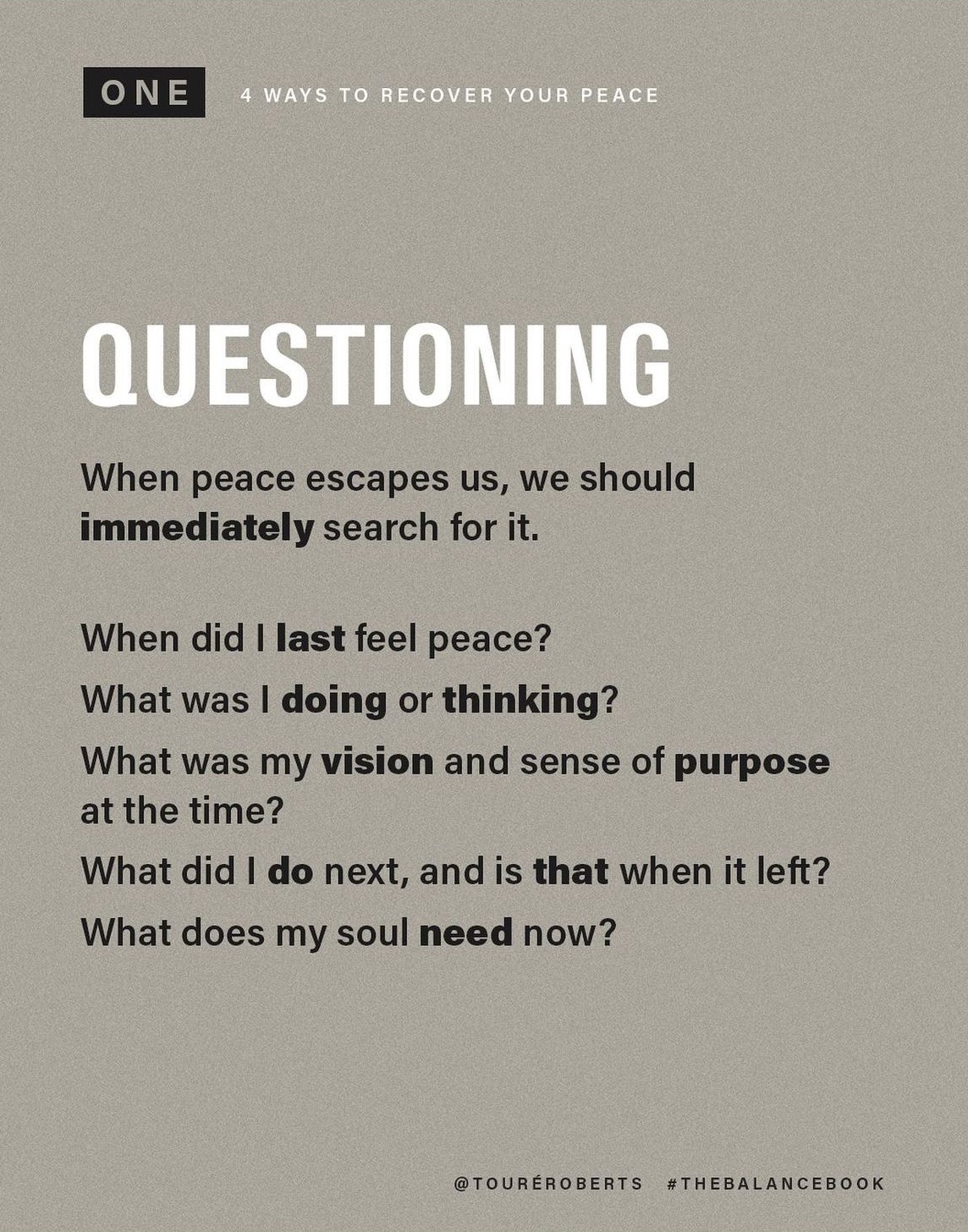
I got this from Toure Roberts Instagram a few years ago. It was a screenshot that I had saved in my phone and kept coming back to because it continued to speak to me.
Before we rush to figure out how to find peace, it helps to slow down and notice when we last felt it. Peace often leaves quietly, not with a crisis but with distraction. This is an invitation to pause, reflect, and listen for what your soul and God may be asking of you right now.
Paying attention is the first step. In the next post, we’ll explore how peace is formed and re-formed by where our minds are anchored and what we choose to trust each day. I know this feels like its ending on a cliff hanger but trust me, this is going to be good.
Until next time,
Dominique
Advice for my teenage self
What advice would you give to your teenage self?
Slow down. Listen more. You don’t know everything and that’s ok.
You don’t need to prove anything to anyone.
The things that feel life-or-death right now?
Most of them won’t matter in a few years.
The embarrassment.
The comparison.
The need to win.
The need to be right.
Peace is stronger than being loud.
You don’t have to defend yourself every time.
You don’t have to change anyone’s opinion to validate your own.
Confidence doesn’t argue.
Choose a college. Choose a major. Choose a path based on what you actually enjoy , not what sounds impressive. Not what makes the most money. Not what makes other people proud.
Money is useful.
But alignment is precious.
You are allowed to build a life that fits who God made you to be.
If I could sit beside her now, I wouldn’t just give advice.
I would tell her to walk with God sooner.
To pause before reacting.
To ask before choosing.
To let Him shape her identity before the world tried to.
Because everything she was trying to prove,
God was already forming.
Until next time,
Dominique
What Fasting Taught Me
Fasting taught me to slow down and pay attention.
I became more aware of what I was taking in—and what was coming out. The thoughts I entertained. The words I spoke. I noticed how often I was thinking or saying things that weren’t beneficial or even necessary.
I also learned something important: inertia creates more inertia, but momentum does too. I was surprised by how much I could get done in just fifteen focused minutes once I started.
Hunger has a way of stripping life down to what’s essential. It sharpens your focus. It forces you to confront what really matters and what doesn’t. This fast felt like a jumpstart into a new season, a reset that made some things crystal clear.
Removing the internal clutter helped me see what needs my attention and what I need to release. It even changed how I thought about food. When you haven’t eaten all day, you don’t want to break your fast with pizza. You want something that will actually nourish you.
That’s how I want to live moving forward, more intentional about what I consume, what I produce, and what I allow to stay.
The practices I’m carrying into March:
• Slowing down enough to notice what’s shaping me
• Choosing nourishment over convenience, in my habits, my words, and my focusThis fast wasn’t just about abstaining. It was about alignment.
Until next time,
Dominique
Day 3- Walk
Walk doesn’t feel big or splashy like awareness or surrender and it isn’t supposed to.
Walking is choosing, day by day, to slow down and be led. It is deciding to stay close because God is not in a hurry. He rarely gives us all the steps at once, not because He is withholding, but because He knows how quickly we would run ahead of Him.
We can’t see what He sees.
We don’t see the danger ahead, the heartbreak we’re not ready for, or even the blessings our character can’t yet sustain.
Walking builds endurance.
Walking with God is a posture of trust.
Obedience builds confidence.
When you take the first step He’s given and discover He meets you there, something shifts. Then you take the next step. And then another. Over time, you begin to recognize the rhythm of His leading.
People often ask, “How do I know if this next step is God or just me?”
One guide is this: God’s steps may cost us comfort, and they may even break our pride, but they are never reckless.
God may lead us into pressure that exposes our weakness or strips away what we rely on, but He does not abandon us in it. His steps are purposeful, even when they feel heavy. Refining, not random.
If a step is driven by urgency, fear, or the need to control the outcome, it is likely coming from us. God’s leading may be difficult, but it carries His peace beneath the weight.
Scripture anchors this promise for us:
“Walk in obedience to all that the Lord your God has commanded you, so that you may live and prosper and prolong your days in the land that you will possess.”
Deuteronomy 5:33 (NIV)
This promise isn’t about speed or success it’s about a life that is sustained, steady, and protected through obedience.
Walking with God is not about speed.
It is about staying close.
And today, faithfulness looks like taking the next step you already know and trusting God with the rest.
Day 2-Surrender
Jeremiah 13:1–7
God told Jeremiah to buy a belt, take a long journey to hide it, then return later to dig it up. When he finally retrieved it, the belt was ruined—no longer useful.
Jeremiah wasn’t told why at the beginning.
He didn’t receive the full explanation upfront.
He obeyed first—and understanding came later.
Each step required trust. Each instruction revealed only what was needed for the next act of obedience. God did not give Jeremiah the full picture, only the next direction.
This is often how God works with us.
When we are determined to follow our own way, it becomes difficult to hear God’s. Our expectations, timelines, and assumptions can drown out His voice.
Day one was about awareness, revelation.
God, reveal in me my blind spots.
Day two is about surrender.
Our prayer today is not complicated, but it is costly:
Lord, Your plan, not mine.
Help me release the outcome and what I think this season should look like.
Help me see things from Your perspective, not my own.
Teach me to wait for each step.
Give me a willing heart to obey, even when the full plan isn’t clear.
Today, we loosen our grip and allow God to lead again.
We surrender our attitude of expectation and trust His direction.
God’s ways are not our ways.
Surrender is how we realign ourselves to His.
Day 1-Examine
This is what the Lord says:
“Stand at the crossroads and look;
ask for the ancient paths,
ask where the good way is, and walk in it,
and you will find rest for your souls.
But you said, ‘We will not walk in it.’ Jeremiah 6:16 NIV
How is your soul feeling today?
Do you feel rested?
On day one, we pause to examine where we really are in our daily walk with God. On paper, you may be doing all the “right” things—reading Scripture, studying the Word, gathering with other believers, watching or attending church. And those things matter. But they can still remain surface-level.
Is it possible that some of this has become lip service?
The Israelites were doing many of these same religious practices, yet they were also worshiping Baal and other gods—right in the temple of God. Maybe they thought they could cover all their bases. A spiritual two-for-one deal. That sounds extreme… but do we do the same thing?
How often are you trying to make a way instead of waiting on God’s way?
How often are you “helping” God along because it feels like He’s moving too slowly?
Notice what God says in this verse: ask for the good way—and walk in it—and you will find rest for your souls.
Not run.
Not rush.
Walk.
How often are you actually asking God about His plans for you—and then waiting for His response?
This intentional time is about clearing out the noise so we can hear more of God and less of ourselves, less of the pressure, less of outside influence. It’s an opportunity to realign—to check whether we’ve wandered off the path while waiting, simply because waiting felt too long.
The beautiful thing about God is that His way is clear. And if we’ve drifted, we are always invited to return.
Prayer
Lord, show me what I’ve ignored. Reveal where I’ve been moving blindly in my own way instead of following You.
Show me where I’ve been going through the motions—doing what looks right, but with a heart that wasn’t fully after Yours. Gently lead me back to Your path. Remind me of Your plans for me—plans for good.Give me the rest, peace, and strength that only You can give.
Amen.
Until next time,
Dominique
 Always finding the silver lining